❦ Autumn notes
Raised Garden Bed with Trellis: What to Look For Before You Buy
What to look for in a raised garden bed with a trellis: wind, shade, reach, anchoring, and a buyer's checklist that keeps a shallow box from becoming a sail.
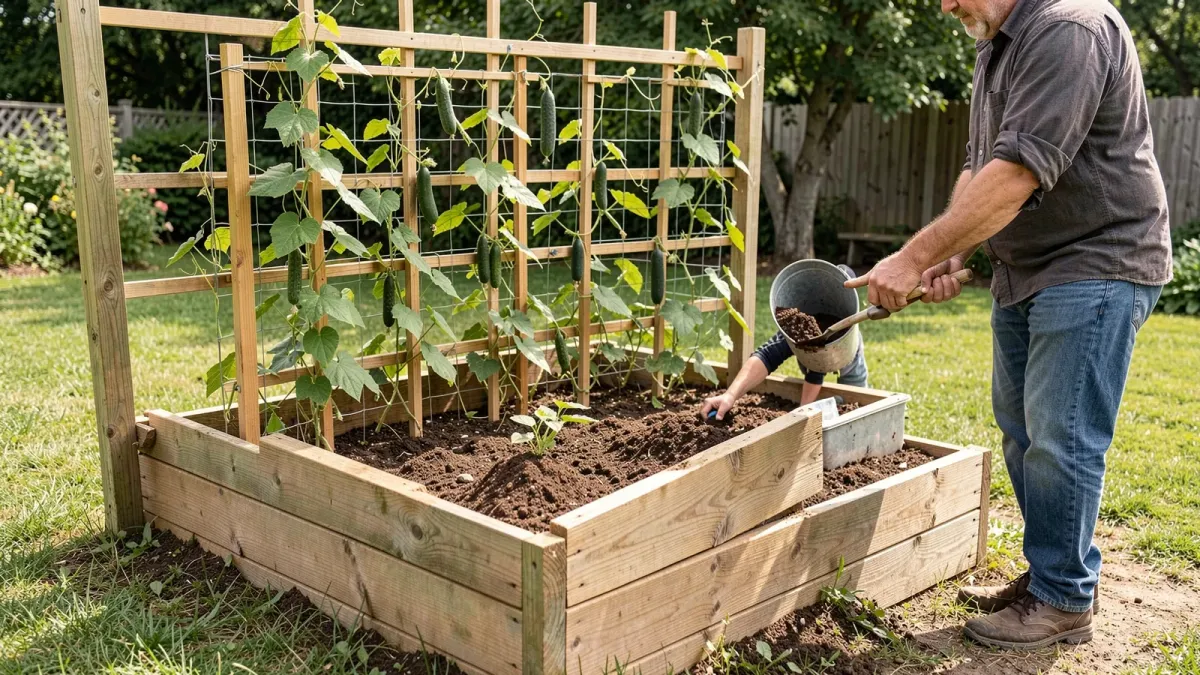
The bed and the trellis have to work as one object
A raised garden bed with a trellis looks simple in a catalog: a box, a screen at one end, a photograph of peas. In the garden, it is a small engineering problem. The trellis catches wind. The bed is a shallow box of soil. If the two are only lightly screwed together, a July wind can treat the whole thing as a sail. We learned this on a narrow bed that we "finished" with a tall mesh panel and four short screws. The panel did not come down, but the bed shifted, and we spent an evening putting the system right with better posts.
This is a what-to-look-for guide, not a ranked list of kits, and not a set of invented product tests. Measure the bed, name the crop, and decide whether the trellis should be attached to the box or stand on its own feet in the ground.
University extension advice on vegetable spacing, sunlight, and supports is worth reading for your crop and your state, including current pages from services such as Penn State Extension or another land-grant extension in your region. If you garden in Britain, the Royal Horticultural Society is a useful official plant resource. Those pages will not sell you a kit. They will remind you that vines want sun and a support that is already in place when they start to climb.
Look at load, light, and the way you will work the bed
A raised garden trellis, a garden bed trellis, and a complete "raised garden bed with trellis" kit are the same family of decisions.
| Decision | What to look for | What we would not do again |
|---|---|---|
| Position | Usually the north side of a bed in the northern hemisphere, so the screen does not shade the whole box all day | A tall panel on the south edge that left the salad crops in shadow |
| Height | The mature crop, and whether you can still reach the back of the bed | A decorative 90-centimeter panel under runner beans that wanted twice that |
| Attachment | Posts that go into the ground, or a frame stout enough that the box is not the only anchor | Short screws into thin cedar as the only plan in a windy yard |
| Bed depth | Enough soil for the crops you want, and a width you can reach across | A handsome, too-wide box you cannot weed without standing in it |
| Material at the soil line | Wood, metal, or other materials you are willing to maintain in wet soil | A mystery treated board, or a thin metal edge that buckles |
| Access | Space to walk, kneel, and set a trug down | A trellis that blocks the only working side of the bed |
If you already have a bed, a separate trellis with its own posts can be a better buy than a kit that assumes a box you do not have. If you are buying both together, lift the corner of the design in your mind and ask what happens when the vines are wet and the wind comes sideways.
A buyer's checklist for a raised bed with a trellis
- You can name the first crop: peas, beans, cucumbers, tomatoes, or something else, and you know its rough mature size
- The panel will sit where it will not shade the rest of the bed more than you can accept
- You can reach the back of the box from the path
- The trellis has a real anchoring plan, not only a decorative lip
- The bed width is a comfortable reach, even after the vines fill in
- You have thought about irrigation: a wall of leaves can hide a dry corner
- You can install the support at planting time, or immediately after, without crushing roots later
- Materials at the soil line are ones you are willing to inspect and maintain
- The kit, if it is a kit, still works on your ground, which may not be level
If a design is tall and the bed is shallow, plan on independent posts. That single decision would have saved us a Saturday.
How we use a bed-and-trellis now
We plant the climbers at the base of the support, keep an aisle clear, and tie only as needed with soft ties. We do not let a cucumber or a tomato lean on a neighbor's stem for "support." We also do not pretend a mesh panel is a privacy fence. If you want privacy, that is a different, heavier structure.
Soil in a raised box dries and warms faster than a plot in the ground, which can be a gift in spring and a chore in a hot week. Water the root zone, not only the leaves on the screen. Mulch if it suits the crop. These are ordinary habits, and they matter more once the trellis is full and you can no longer see the soil at a glance.
If you garden with children, choose a panel without sharp edges at eye height, and do not use a shaky arch as a climbing frame. A trellis is for plants.
Kits, homemade panels, and the middle path
A kit can be a good buy if the wood is stout, the panel is sized to a real crop, and you are still allowed to add longer posts. A homemade panel of stock fencing and two metal posts can be plainer and stronger. The middle path, which is the one we now like, is a simple box we already trust and a trellis we built or bought to match the crop, not a single catalog photograph.
If you are handy, still measure twice. A panel that is out of square will be a daily irritation, and a fence cut that leaves sharp wire at hand height is a poor welcome in a family garden. File or cap the ends, and put the messy side where you will not lean on it.
Questions to ask before you buy
Should the trellis be attached to the raised bed or be freestanding?
If the panel is short and the site is sheltered, a stout, well-built attachment can work. If the panel is tall or the site is windy, freestanding posts in the ground are usually the kinder design. The bed can still sit in front of the panel.
How tall should a raised garden trellis be?
Tall enough for the crop you actually want to grow, and still low enough, or still well-anchored enough, to take wind. Peas and smaller vines need less than vigorous beans or indeterminate tomatoes. Match the tool to the plant.
Can I add a trellis to a raised bed I already have?
Yes. That is often better than replacing a serviceable box. Set posts just outside the frame if you can, so you are not relying on thin timber sides, and do it before the midseason tangle.
Will a trellis on the bed keep vegetables cleaner?
It can, by lifting fruit and leaves off wet soil, which is one reason extension services like supports for crops such as cucumbers and tomatoes. It will not replace watering, picking, and looking at the plants. A clean fruit is still a fruit you have to go and get.